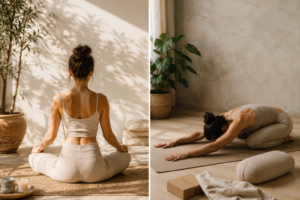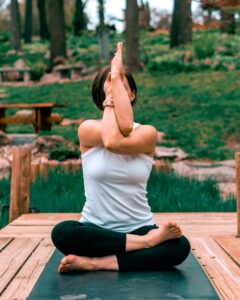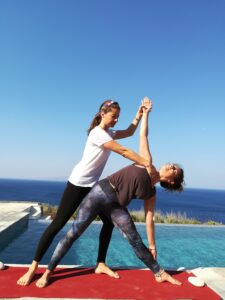
If you are looking for yoga for weight loss, you may come across many strong and energetic yoga practices.
This practice is different.
As a Yin Yoga teacher, I don’t see movement only as a way to burn calories or change the shape of the body.
Yin Yoga is slow.
It gives us time to become quiet, notice sensations and listen to the body.
This gentle practice can be included as part of a wider approach to healthy weight management, alongside regular walking, strength or cardiovascular exercise, nourishing food, adequate sleep and rest.
The poses below are not intended to directly cause weight loss. Instead, they offer an opportunity to slow down, move gently and develop greater awareness of the body.
Before you begin
You will need:
- A yoga mat
- One or two cushions or a bolster
- Two blocks, if you have them
- A wall
Move slowly and stay within a comfortable range.
In Yin Yoga, you may experience sensation, but you should not feel sharp, painful or threatening sensations.
You do not need to achieve the deepest version of a posture.
Your body is different every day.
Let the practice meet you where you are.
1. Butterfly
Baddha Konasana
Sit on your mat and bring the soles of your feet together.
Allow your knees to open naturally.
You can place cushions or blocks underneath your knees if this feels more comfortable.
Slowly allow your spine to round forward.
There is no need to pull yourself down.
Let your arms and head become heavy.
Stay for 2–3 minutes.
Notice the sensations through your inner thighs, hips and back.
Let your breathing remain easy.
To come out: slowly walk your hands back towards you and gently bring your knees together.
Image: Butterfly Pose
2. Dragon
Yin Yoga Low Lunge
Come onto hands and knees.
Step your right foot forward between your hands.
You can place your hands on blocks or on the floor.
Allow the hips to soften forward and down without forcing.
Your back knee can remain on the floor.
If this feels too strong, bring your front foot closer or use more support.
Stay for 1–2 minutes, then slowly come out and change sides.
The intention is not to find the deepest possible stretch.
Instead, find a place where you can breathe and stay.
Image: Dragon Pose
Yin variations of Dragon Pose here.
3. Caterpillar
Seated Forward Fold
Sit with your legs extended in front of you.
Allow your knees to bend as much as you need.
Slowly fold forward from the hips and let your spine round naturally.
You can rest your head on a cushion or bolster.
Do not pull yourself deeper.
Simply allow gravity to do some of the work.
Stay for 2–3 minutes.
Keep your breathing soft and steady.
To come out: slowly walk your hands back towards you and return to an upright position.
Image: Caterpillar Pose
Link to caterpillar pose variations
4. Sphinx
Lie on your stomach.
Place your forearms on the floor with your elbows underneath or slightly in front of your shoulders.
Let your chest gently lift.
Keep the front of your hips and legs relaxed.
You should feel a gentle sensation through the front of the body, not compression or pain in the lower back.
Stay for 2 minutes.
If the pose feels too strong, move your elbows further forward or lower your chest.
A cushion or bolster can also be used to create more support.
Yoga Journal recommends using support underneath the chest for a gentler version of Sphinx.
Image: Sphinx Pose
5. Supported Bridge
Lie on your back with your knees bent and feet on the floor.
Lift your pelvis gently and place a yoga block or firm support underneath your sacrum.
Once you feel supported, allow your weight to settle onto the support.
Keep your shoulders relaxed.
You can stay here with both feet on the floor.
Stay for 2–3 minutes.
There should be no strain in your lower back or neck.
To come out: press gently into your feet, lift your pelvis and remove the support before slowly lowering your spine to the mat.
A supported Bridge can be modified using different heights of support. A lower support is generally a gentler place to begin.
Image: Supported Bridge
6. Supine Twist
Lie on your back with your knees bent.
Bring your knees towards your chest.
Allow both knees to slowly fall towards the right.
Keep your shoulders comfortable on the mat.
You can place a cushion underneath or between your knees for support.
Stay for 1–2 minutes.
Then slowly return to centre and repeat on the other side.
Let the twist be gentle.
There is no need to force your knees towards the floor.
Image: Supine Twist
7. Legs Up the Wall
Come to sit sideways next to a wall.
Slowly turn onto your back as you bring your legs up the wall.
Your hips do not need to touch the wall.
Find a distance that feels comfortable.
Allow your arms to rest beside you or place your hands on your belly.
Close your eyes if that feels comfortable.
Stay for 3–5 minutes.
There is nothing to achieve here.
Simply rest.
When you are ready to come out, bend your knees and slowly roll onto one side before sitting up.
Legs Up the Wall is commonly practised as a supported, low-effort posture, and variations can be made using blankets or a bolster.
Image: Legs Up the Wall
Finish with a few quiet moments
Lie down comfortably on your back.
Let your feet fall open and allow your arms to rest beside you.
Close your eyes.
Take a few natural breaths.
Notice how your body feels now.
There is no need to judge the practice.
No need to ask whether you did enough.
Simply notice.
Your body is always giving you information.
Learning to listen is part of the practice.
Stay here for 3–5 minutes, or as long as feels comfortable.
Remember
Yin Yoga is not a weight-loss workout.
This practice is intended to complement, rather than replace, other forms of physical activity.
If weight management is one of your goals, a broader approach may include regular movement, strength and cardiovascular exercise, nourishing food, sufficient sleep and adequate recovery.
There is no single approach that works for everyone.
Your body, health, circumstances and needs are unique.
The aim is not to fight your body.
It is to learn how to care for it.
A note before you practise
Yoga is generally considered safe when practised appropriately, but injuries can occur. Practise within your own comfortable range and do not force a posture.
If you are pregnant, recovering from an injury, have a medical condition, or are unsure whether a particular posture is appropriate for you, seek advice from an appropriate healthcare professional or qualified yoga teacher before practising.
This practice is provided for general educational purposes only. It is not medical advice and is not intended to diagnose, treat or prevent any medical condition.
For visual guidance, you can also explore the Yin Yoga pose demonstrations from Yoga Journal linked throughout this article.